Asset disposal process for solid state drives

We ran across a compelling article on Inside Analysis called, “Is Spinning Disk About to Die?” which argues we may be at a tipping point regarding the use of Solid State Drives (SSDs) instead of hard disk drives (HDDs).  Here’s an excerpt:

Spinning disk, or hard disk drive (HDD), has been under threat for quite a while with the cost of solid-state drive (SSD) falling at about 50% per annum. But in the past year or so, the price of SSD – or flash memory devices – has fallen faster and it is becoming disruptive. 

You tend not to use all of an HDD, but you can and are eventually likely to fill an SSD to capacity – so SSD has greater capacity than the raw store capacity figures suggest. HDD consumes more power, takes more data center space and requires more data center labor. SSD is faster to read and write than high performance HDD, and that matters for many applications, but there is no easy comparison to make here – it is very contextual. It’s also a changing picture, mainly because SSDs are on an accelerating technology curve.

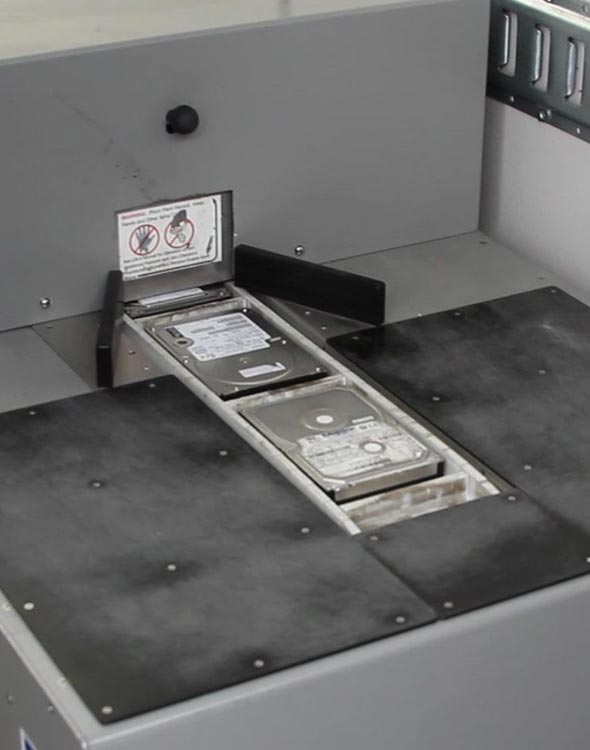
Why is this important to those responsible for end-of-life IT asset management and IT asset disposal/disposition (ITAD)?  Because at some point, all of these SSDs will need to be upgraded or replaced, and the typical data destruction process will not suffice to protect your data.  As we point out in this October 2012 blog post, shred particle size is critical.

The best practice to destroy a solid-state drive is via hard drive shredding. (But) we discovered that the shred width (particle size) was critical to the success of destroying the small memory chips in SSDs where the data is stored. Typically, a shred width of ½” or smaller is needed to break through the small memory chips and securely obliterate the data. Many standard industrial shredders will shred to 1” particle size, thus allowing the memory chips to slip through the hammers that shred the data, leaving sensitive information in tact. When destroying SSDs, awareness of the appropriate shred width distinction to break through the memory chips is crucial.

So make sure you update your end-of-life process for SSDs by ensuring your service provider can deliver the small shred size necessary to render the data useless.

And click here to learn about Securis’ Micro-Shredding service for Solid State Drives (SSDs), flash drives and micro SD cards.

Securis in the Community: The JDRF Walk to Cure Diabetes

Along with a half-million others nationwide, Securis team members participated in the JDRF Walk to Cure Diabetes this past weekend.  JDRF raises vital funds that power the global movement to help cure, treat and prevent type 1 diabetes (T1D).

We are proud to take steps to help JDRF achieve its goal of improving the lives of all people affected by type 1 diabetes (T1D) by accelerating progress on the most promising opportunities for curing, better treating, and preventing T1D. The money Securis raises will go directly to support research with the greatest potential to conquer this disease.

The Walk to Cure Diabetes was a wonderful way for our employees to make a difference in our community. It brought us together for an important cause; gave our friends and family a day of fun, food, and entertainment; and most of all, allowed us to make an impact on the lives of people with type 1 diabetes.

Lives of people with type 1 diabetes

Micro-Shredding Solution for Solid State Drives

NEW! Securis announces “micro-shredding” process exclusively for Solid State Drives (SSDs), flash drives, SD cards, and other small storage devices and media.

Did you know that Solid State Drives (SSDs), flash drives, and micro SD cards will literally fall through the cracks of most data destruction and recycling processes?

That’s why Securis has added a “micro-shredding” process that goes beyond traditional shredding and pulverizes devices into 2MM “e-crumbs.”

And when you combine Securis’ micro-shredding solution with our degaussing services, inventory tracking, and reporting and secure chain of command, you get unmatched levels of security and confidence.

Contact Securis today at info@securis.com or 800-731-1909 to learn more.


Destroying Solid State Drives– Size Does Matter

Destroying Solid State DrivesCompanies that are storing and utilizing massive amounts of data are finding solid-state drives (SSDs) enticing as an alternative to traditional, electromechanical disks. These new, efficient drives employ memory chips instead of spinning platters to store information. Because there are no moving parts to the drive, they are typically smaller, last longer, and consume less energy.

A few months ago, we were approached by one of our customers to help them develop a solution with us to securely destroy their solid-state drives that have failed or have been decommissioned. We accepted the challenge and here’s what we found out about the destruction of solid-state drives:

1. Degaussing won’t work. A solid-state drive uses integrated circuit assemblies to store data, unlike traditional hard disk drives. The data on SSDs is virtually unaffected by the method of degaussing. Although degaussing is the absolute best practice for traditional hard drives, it erases data by reducing or eliminating the unwanted magnetic field (information). Because SSDs do not store data magnetically, they are not able to be securely destroyed via traditional methods.

2. Shred particle size is critical.  The best practice to destroy a solid-state drive is via hard drive shredding. After a few tests with our client, we discovered that the shred width (particle size) was critical to the success of destroying the small memory chips where the data is stored. Typically, a shred width of ½” or smaller is needed to break through the small memory chips and securely obliterate the data. Many standard industrial shredders will shred to 1” particle size, thus allowing the memory chips to slip through the hammers that shred the data, leaving sensitive information intact. When destroying SSDs, awareness of the appropriate shred width distinction to break through the memory chips is crucial.

3. Trackable inventory is necessary. From cradle to grave, management of IT assets requires a leak-proof system that accounts for the location and status of each asset. With an auditable, trackable, and indisputable inventory record of each destroyed SSD, liability and risk are greatly minimized. If you have sensitive data, assurance that it is gone for good with the correct documentation is not only peace of mind, but can also save you from damages in the event of a breach.

The modernity of this technology has sparked the need for innovation in responsible and secure disposal for SSDs. Knowledge of the best practices when it comes to the last 100 yards of an IT asset’s end-of-life is essential to managing risk. With solid-state drives, always make sure your in-house solution or current vendor is utilizing the correct shredder to guarantee physical destruction of the data. The emergence of solid-state drives is why Securis has invested in the necessary technology to dispose of them properly.

Electronics Recycling FAQs

Why Should I Recycle?

Most electronic consumers in the United States do not realize the impact of e-waste on the local and world environments; they simply view their obsolete electronics as trash. According to the Environmental Protection Agency‘s (EPA) 2009 statistics, 3.19 million tons of e-waste was generated, and this number continues to grow.1 These electronics contain materials such as antimony, arsenic, lead, and mercury that are unhealthy to us. It is surprisingly easy for these materials to ultimately end up in our bodies and cause major issues including lung damage, cancer, and seizures.

One color monitor alone contains 6 ½ pounds of lead and measurable amounts of cadmium, mercury and other toxic metals. At Securis, EVERY PART of your electronic assets is recycled. Each item is strategically and securely dismantled. All toxic elements are responsibly disposed of, and all remaining metals, plastics, glass and circuitry is processed domestically.

What Items are Considered to be Electronics?

Under the Resource Conservation and Recovery Act (RCRA) issued by the Environmental Protection Agency (EPA): televisions, monitors, computers, computer peripherals, audio and stereo equipment, VCRs, DVD players, video cameras, telephones, facsimiles, copying machines, cellular phones, wireless devices and video game consoles are primary examples of electronics. Kitchen appliances and other household electronics can also be recycled. Securis will accept practically anything with a plug.

Why Prevent Electronics from Entering a Landfill?

Some electronic device components contain constituents that, if improperly handled, could be harmful to the environment and its inhabitants. E-waste that is not recycled ends up in the environment. Water is poisoned, air turns toxic, soil becomes dead, and wildlife and plant life suffer. Certain components of electronics contain measurable amounts of regulated heavy metals, including lead, silver, barium, cadmium, and mercury. Many of these metals can be recovered and responsibly disposed of, based upon Environmental Protection Agency standards.

How Will Recycling My Obsolete Computer and/or Electronic Equipment Make a Difference?

It is estimated that of the approximately 250,000,000 tons of solid waste generated annually in the United States, around 5% is classified as e-waste.2 Of this, only an estimated 10% to 18% of electronics are recycled (according to WellHome’s 2011 Infographic).3 Securis wants to help change this for the good of our local and global environments.

What are the Outcomes if We Dispose of Electronics Improperly?

NOTICE OF VIOLATION as issued by the Resource Conservation and Recovery Act. Failure to correct the alleged violations cited required by this NOTICE, may result in the assessment of penalties, not to exceed $27,500 per violation pursuant to Section 3008 of Resource Conservation and Recovery Act (RCRA) of 1976, 42 U.S.C. § 6928.

What About Donating My Electronic Assets?

Donation programs can work well if all involved parties understand the limits and liabilities associated with the transfer of equipment. Questions such as, ‘who will ensure that proprietary data is eliminated before the donation’ need to be answered prior to ownership transfer. The Gramm-Leach-Bliley Act of 1993, Health Insurance Portability and Accountability Act (HIPAA) and many others makes all companies and organizational entities legally responsible for the protection of client privacy. Failure to effectively destroy all informational data prior to the transfer of ownership leaves an organization open to corporate liability. Securis’s Data Destruction process helps eliminate the worry of such a risk.

Isn’t My Equipment Worth Something?

With the cost of new computer equipment dropping each year, your used devices are worth less and less. The resale market for used equipment in the United States is extremely low due to regular product innovation. Simply put, older machines regularly do not fit the system requirements needed to optimally run the newest software programs. Machine upgrades have become less of a priority for most organizations, given that they can purchase a new machine cost-effectively. However, Securis recognizes that some equipment may retain some portion of its residual value. In these situations, Securis will credit a portion of the residual value back to the customer to cover recycling costs on a consignment basis.

Why Does it Cost Money to Recycle Electronics?

Materials such as antimony, arsenic, lead, and mercury used to manufacture electronics are unhealthy to us. If not recycled properly, it is surprisingly easy for these materials to ultimately end up in our bodies and cause major issues including lung damage, cancer, and seizures. E-waste that is not recycled ends up in the environment. Water is poisoned, air turns toxic, soil becomes dead, and wildlife and plant life suffer. 3

To avoid these harmful effects on both our bodies and our environment, reputable e-cycling companies provide outlets for responsible riddance of your old electronics. As we’ve mentioned in a previous blog post, some of these companies lower their costs by exporting e-waste to countries like Ghana, Nigeria, Pakistan, India, and China where it gets broken down by men, women, and children who are usually unprotected from the toxins. To comply with government regulations and environmental laws, e-cycling companies are resorted to charging fees to properly break down hazardous electronics.

The Electronics TakeBack Coalition gives consumers tips on how to spot a fake recycling company. They recommend finding out who is paying for the recycling cost, especially if there is no request for a small recycling fee. These fees ensure that what you are recycling is handled responsibly and complies with government regulations, including whether or not this process takes place in the United States or overseas.4

  1. http://www.epa.gov/osw/nonhaz/municipal/pubs/msw_2010_rev_factsheet.pdf
  2. http://www.greenpeace.org/usa/en/campaigns/toxics/hi-tech-highly-toxic/e-waste/
  3. http://www.treehugger.com/clean-technology/crazy-e-waste-statistics-explored-in-infographic.html/
Giving Back to Our Community

‘Tis the season for giving and Securis would like to take a moment to recognize one of our partners. For the past seven years, Securis and Fairfax County’s Work Awareness Transition (WAT) program has been able to provide youth with disabilities a place to learn skills outside of the classroom.

With tremendous help from Sue Collins, Employment and Transition Representative at Chantilly High School, and special education teachers at Chantilly High School, Securis offers technical and career-based training to students with learning disabilities. This award-winning program gives students hands-on experience that encourages development of job skills while learning about the business as a whole.

Andrew Portare, Operations Manager for Securis, meets with some of the students twice a week to cover topics like business etiquette, “how to get hired”, and work ethics. The students also partake in activities ranging from breaking down computers, separating parts, and sorting and cutting wires, to participating in safety, security, and corporate development training. Problem-solving skills are refined by challenging the group to complete designated tasks, like removing specific parts from a computer. In addition, students have gained an in-depth understanding of the electronics recycling industry and the required elements to ensure a business operates smoothly.

We are excited to continue the development of this program to incorporate the interests of the students in a way that cultivates “real-world” experience. Sue Collins and the dedicated team of teachers at Chantilly High have helped us make this program a viable learning opportunity for the youth of our community.

4 Reasons Why Employee Background Checks are Important

Your company’s data is sensitive, proprietary, and extremely important to the survival of your business. A recent study by the Ponemon Institute indicated that the average data breach cost is $7.2 million in the United States. For this reason, it is a best practice to choose a data destruction vendor that requires employee background checks before hiring. When 10% of all data breaches are known to occur during the disposal process, assurance that your data is in good hands can be valuable peace of mind.

Here are Securis’s top 4 reasons why employee background checks are essential:

  1. Protection from liability– Imagine the unlikely happened, and a data breach occurred at your data destruction vendor. Chances are, you would want to be able to tell your lawyer that your vendor had an extensive screening process for all employees to protect against a breach.
  2. Protection against a data breach– The last place most companies want their data is in the hands of a criminal. Background checks on employees are extra protection against a data breach and a precaution that proves that your data destruction vendor commits to its duty of care when dealing with your sensitive data.
  3. Added security redundancy– Data destruction companies often have several security measures to defend your data, but background checks add another layer of protection for your benefit.
  4. Integrity and Ethical Standards– The background check requirement that data destruction companies set is a natural part of the strong commitment to ethical standards and reassures the customer of the company’s integrity.

Securis commits to providing the safest atmosphere for data removal and destruction. The vendor that is used for our employee background checks is Kroll Incorporated. Kroll Inc. is headquartered in New York and has over 65 offices in 25 countries. Kroll Inc. has a multidisciplinary corporation of more than 3,800 employees and serves a global clientele of corporations, financial institutions, government agencies, law firms, non-profit institutions, and individuals. Securis uses Kroll Inc. because they provide the best, most reliable background screenings.  Our employee screening process consists of the following:

  • Search the county criminal record for the past five years of residency in the counties where the employee lived.
  • Driving Record – The driving record (motor vehicle record) will verify the driver’s license number, status, and state of issuance and may provide information such as full name and physical description, as well as recent moving traffic violations and accidents.
  • Federal Criminal National Record Search
  • SSN Trace & Address Locator Database
  • U.S. Criminal Records Indicator Search
  • Securis’s access employees also complete Federal Bureau of Investigation official fingerprint cards. This information and results from background and security checks are kept in each employee’s file for customer review.