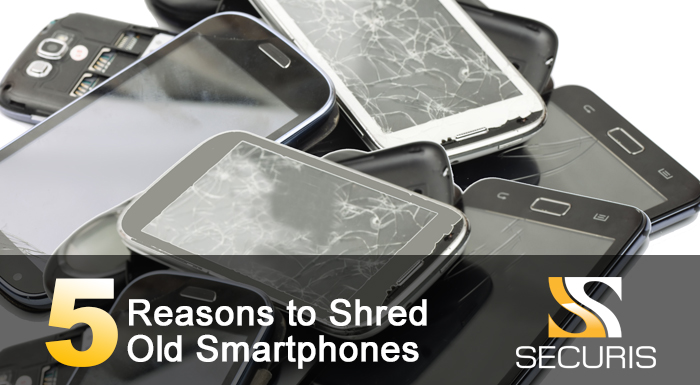
Five Reasons to Shred Your Old Smartphones

Smartphones can connect to almost every part of your business network, every file and email, dashboards, apps, and all of the proprietary information you have on your network. And, these devices seem to become obsolete every year or so, with customers and staff always demanding the latest and greatest, which is why you need to shred old smartphones.

Transferring all of the data to those devices and then removing it from these phones are both monumental tasks. A simple reformatting, resetting, or push back to factory settings doesn’t completely erase your smartphone’s hard drive.

You need to shred old smartphones to properly protect your network. And, if you’re wondering why here are a few things to keep in mind.

Five Reasons to Shred Old Smartphones

1. Factory Resets Don’t Always Work

Factory resetting is the most commonly prescribed method by carriers, but it doesn’t wipe all of your data. That’s not just us saying it; the identified risk also comes from a thorough review of the policies and procedures across multiple carriers and devices from a Cambridge University team.

In their research, 80% of the time they were able to recover a master token, which a smart hacker could use to recover emails, cloud-storage access, contacts, calendars, and other data that can be downloaded by syncing the device.

The big news here is that manufacturer software doesn’t always wipe Flash storage. It’s incredibly hard and even the top tools tend to fail some of the times.

The only thing to guarantee success is to shred old smartphones. Securis offers microshredding technology to guarantee that you shred old smartphones to the proper particle size.

2. It’s More than Just a SIM

One of the biggest mistakes we see is that people think removing the SIM card from your device will wipe away all of the information from a device. Unfortunately, even for phones where you can access and remove the SIM card, internal components you can’t remove will store a variety of information.

There are a lot of components you’ll have to contend with if you’re trying to remove your information, and ripping all of those away typically means it can’t be reused. Destroying it all yourself can be difficult and harmful to your team, and oftentimes it takes more than just physically disconnecting different elements.

3. A Hammer Isn’t Enough

Recent political scandals and football scandals have prominently featured phones that were destroyed, with reports saying the owner or a staff member took a hammer to the device. That destruction of physical elements doesn’t always mean true destruction of data.

Eric Brown, a lab manager at the forensic data-recovery firm Flashback Data, says that this type of physical attack may not actually harm the memory chips and other components that need to be destroyed. His company recommends shredding because it prevents the ability for undamaged components to be put in a new phone and have their data accessed.

Use the right tool for the right job, and that means you need to shred old smartphones.

4. People Only Need a Little Information to Hack You

Today’s thieves only need a little bit of information to harm your company. All it takes is access to an email address or a system dashboard to start getting to the heart of your data, whether that’s customer credit cards, bank accounts, contact information, HR documents, and other personal information. If you shred old smartphones, thieves cannot access sensitive data.

5. Lives Are On Our Smartphones

In a world where everything is connected, we’ve got a lot more points of vulnerability. And that vulnerability is for you and your team. Social networks, personal emails to family, photos of children and so much more are going to be on these devices, even if they’re supposed to be used only for work.

Why take the risk that this could fall into the wrong hands? Why risk that liability of loss?

That’s why we at Securis always recommend that companies, governments, and individuals always shred old smartphones.
What Is a Degausser and How Does It Work?

A degausser is a machine that disrupts and eliminates magnetic fields stored on tapes and disk media, removing data from devices like your hard drives. The degaussing process changes the magnetic domain where data is stored, and this shift in domain makes data unreadable and unable to be recovered.

Degaussers work on hard drives in most of today’s devices, VHS tapes, cassettes, LTO and DLT tapes, and other storage devices. However, they do not work on compact disks and other optical storage elements.

Degaussing represents one of the best steps to take before destroying or shredding hard drives, by giving you an extra layer of protection against someone accessing your information illegally.

Degaussers in Action

A degausser generates a controlled magnetic field that it uses to remove information. Your equipment all has an Oe rating that lets us know how strong of a degausser is needed to remove the information on that storage medium.

The typical hard drive uses a circular flat piece of metal with an iron oxide or chromium dioxide coating to create and store information. Electrical pulses move through a coil in the head of the hard drive to magnetize part of the metal and position the coating to store information in binary.

Degaussers generate magnetic fields that disrupt the coating and removes the magnetic memory from it. This ends up completely randomizing the data pattern that exists so none of the information is the same.

After a Degaussing

Many of the devices that we can put through a degausser are still able to be used afterward. Generic magnetic storage devices like reel-to-reel tapes and VHS video cassettes are the most likely to be usable after degaussing. The downside is that these are so old that you generally won’t save any money by trying to reuse them due to the upkeep of older equipment and their limited storage.

Today’s hard drives in your servers, computers, laptops, and tablets, plus many backup tapes, are rendered unusable by the degaussing process. The shift in the magnetic domain is permanent and does irreparable damage, which is perfect if you’re looking to delete information for good.

Degausser Terms to Know

If you’re looking at all degaussing service, there are a few things you’ll want to learn and understand. Here are a couple of the biggies.

Oersted

Oersted (Oe) is the measurement of a magnetic field in a vacuum. You’ll find Oe ratings of about 1800 or higher for current tapes, while hard drives can easily reach 5,000 Oe. These energy level ratings tell you how strong of a degausser you’ll need to destroy the data that’s being stored on the device.

Coercivity

You’ll see coercivity used interchangeably with Oersted in many instances, because coercivity is the among of magnetic field that must be applied to reduce a magnetic induction to zero (which kills data on hard drives). Essentially this is a rating of how easy or difficult it will be to demagnetize your magnetic media.

If you see both used together, just remember this: the higher of either term, the stronger the degausser you’ll need to make sure your information is gone.

Do You Need It?

It’s time to ask the big question: should you use degaussing from a service like Securis when getting rid of your old equipment? We always like to say “Yes!” when it’s data that contains any personal information, credit cards, or anything else that could be used to harm your business, customers, or reputation.

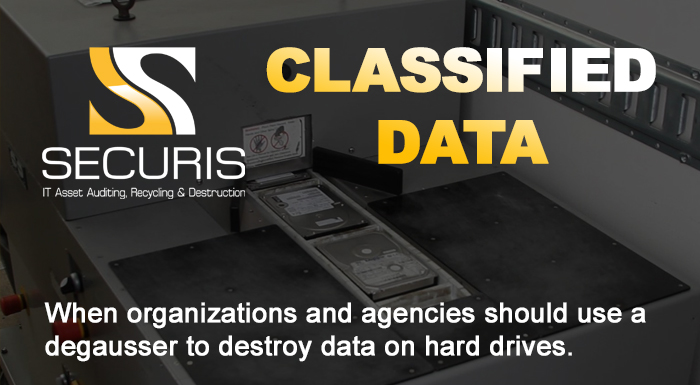
There are a few times where you must use degaussing too. If you’re using any information that requires a clearance level, such as “Classified” or “Top Secret” designations, you must follow disposal standards and procedures that include degaussing.

Degaussing also is always recommended for HR companies, financial firms, companies with proprietary information, and anyone who stores health or personal customer information. It is the best way to secure your data and then follow up with a full hard drive shredding just to be safe.